
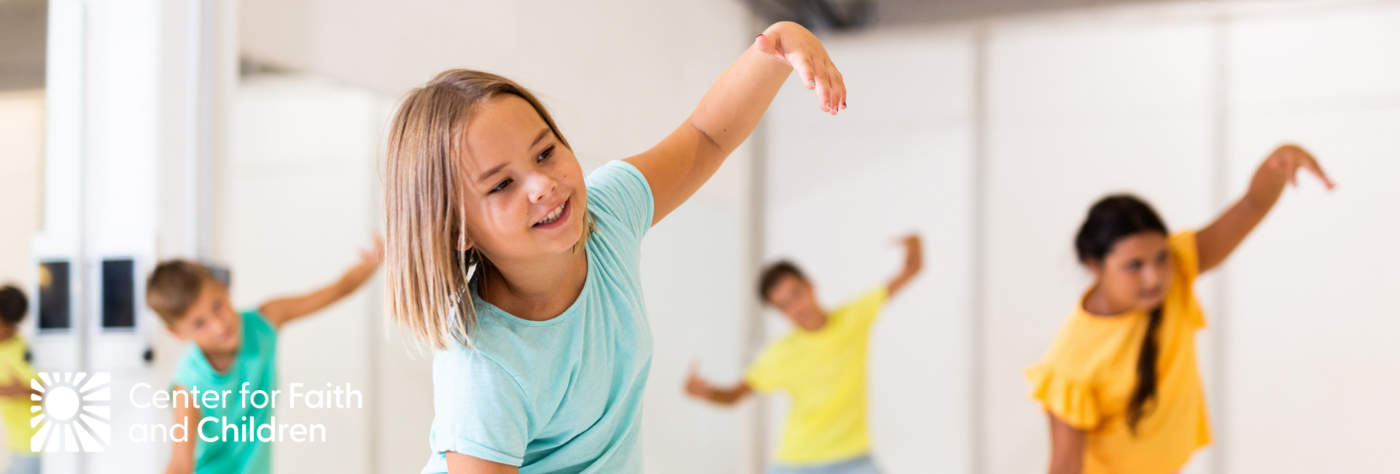
Ever notice the boundless energy and enthusiasm that children possess? Regardless of temperament, children can’t help but stay on the move all the time. Take my son, for example. His new favorite activity is breakdancing, and my goodness, he loves it. He’s 5 years old, and his version of breakdancing involves consistently spinning on his knees, performing rotations that would make me fall over. After several pairs of worn-out pants, I can assure you that he takes his breakdancing seriously. But my son reserves his breakdancing for a very specific time and place: Sunday morning at our church. You see, my son’s breakdancing serves as his pathway to worshiping God. Whenever we are at church, he stands ready to enter the center aisle and dance his heart out. He uses movement and dance to express his love for God.
One of my favorite stories in the Bible is when David uninhibitedly worships the Lord in 2 Samuel 6. David didn’t care one bit about what anyone was thinking around him. He was expressing his love and devotion to God from what was overflowing from his heart. He didn’t hold back. David worshiped with his whole heart. Even when David’s wife despised what he was doing, all David could do was celebrate before the Lord. I often think of this story when I see my son breakdancing. My son is showing what embodied worship and prayer can look like.
The Connection of Mind, Body, Spirit
Young children freely express themselves. Through their bodies, they express what they are thinking and feeling: stomping their feet when frustrated, jumping up and down when they are excited, slumping over when they are sad or disappointed. Children understand the embodiment of being fully present with their bodies as it connects to their mind and spirit. While no child would say the word ‘embodiment’, they know when their body is telling them something important. It seems to me that children know that their minds and bodies are deeply connected. Additionally, children are tenaciously curious. Their willingness to try and understand how something works while simultaneously trying that very thing actively is astounding. Our Creator God built young children to try without fear, to express without shame, and to be present in their surroundings. Children teach us what it means to be embodied, and we need to practice with them so we understand like they do.
In his introduction to the book Praying with the Body, Ron DeLeon writes, “When the body participates fully in our spiritual journey, our relationship with all of creation and with God our Creator is enriched.” Full participation. An enriched relationship. The body is integral to our dialogue with God. And children are already attuned to the connection of mind, body and spirit. The question is: how are we inviting children into that full participation? How are we allowing for embodied prayer and movement to be a key pathway for young children to connect with God?
How lovely is your dwelling place,
Lord Almighty!
My soul yearns, even faints,
for the courts of the Lord;
my heart and my flesh cry out
for the living God.
—Psalm 84:1–2 NIV
Practices of Embodied Prayer and Movement
Embodied prayer and movement can be practiced in different ways. The following practices that I suggest all utilize movement, Scripture, prayer, and connection. Remember: we want to help young children connect with God and be able to explore different pathways to meeting with God.
Praying the Lord’s Prayer with motions—One of the most centering practices we have done in our church community has been the reciting of the Lord’s Prayer. Several years ago, I was taught motions to go along with the Lord’s Prayer, and it completely changed how I prayed the words. My body was invited to fully participate through movement. We now teach this to our children to help them understand the words of the Lord’s Prayer and to have it be embodied from the very beginning. Consider how you might put motions to a recited prayer or Scripture. (Better yet, invite the kids to help create the motions!)
Breath prayers—One of the most calming practices I have found for young children is teaching them how to pray with their breath. Often, when we tell children to ‘just breathe’, it is when they are upset and need to calm down. Rather than telling a child to breathe, you can say, “Let’s take a deep breath and pray.” Breath prayers are tied to our inhale and exhale. For young children, it is very important to keep the prayers short and easy to say. Try some of these with the young children in your life:
Inhale: God, …
Exhale: please help me.
Inhale: God, …
Exhale: You love me.
Inhale: God, …
Exhale: You are with me.
Embodied Worship—We see numerous accounts in Scripture of embodied worship. From God’s people worshiping Him upon their deliverance from Egypt to David dancing before the Lord to accounts of prayer in the gospel accounts, we see how coming before the Lord invites our whole selves to be involved. Some expressions of this for young children are through dancing, clapping, kneeling, drumming with our hands, or raising our hands in praise. One way that I invite children to express themselves in worship is through dancing with ribbons. Allowing children to dance along to worship music while twirling or waving of ribbons gives them a physical reminder that this is set apart.
Psalm Movements—If you are anything like me, I wanted to teach children from the youngest of ages how God created us and how everything we do is a way to worship God with our bodies. One of my favorite books to use to help young children understand this is a movement primer from the Baby Believer board books series. Using stunning illustrations and verses from the psalms, Psalms of Praise by Danielle Hitchen aids in showing children different postures and expressions of movement as an introduction to how worship is a part of everything we do. From standing to kneeling to running and jumping, each page helps a child see how each moment of our day can be a moment of praise to God. We can turn any movement into a prayer because it simply means that we are spending time with God. What a gift!
How might you incorporate embodied prayer and worship with the young children in your life? I pray that anytime you see a young child expressing themselves through movement that you intercede for them, inviting the Holy Spirit to encounter them in a powerful way.
Guest Blogger
-

Kirsten Hitchcock, MA
Kirsten Hitchcock is the Director of Children’s Discipleship Resources at David C Cook and is the Children’s Pastor at The Practice Church in South Barrington, IL. She has worked as a children’s ministry director of churches large and small and has written and developed curriculums and articles for different publishers. She is the secretary of the Children’s Spirituality Summit Board and has an MA from Wheaton College in Christian Formation and Ministry. She is a wife, a mom of two kids, and believes that coffee is a love language.
Read more of her writing on this topic: