
Who made you? God made me.
What else did God make? God made all things.
Kids Catechism Q/A #1 and #2
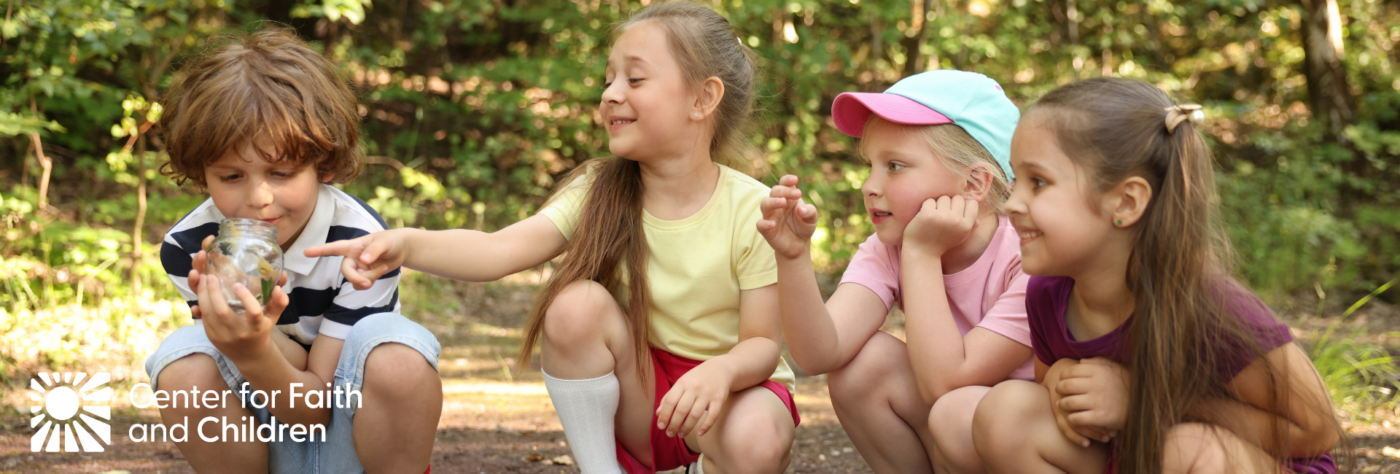
Imagine a child crouching down on a path through the woods with their fingers gently holding a pinecone or on a sidewalk with wide eyes as a ladybug crawls across their hand. With a voice full of wonder, the child asks, “Who made this?” In that simple question, the Kid’s Catechism comes alive. “Who made you?” and “What else did God make?” aren’t questions to be memorized or words on a page, but an invitation to explore. Out in the garden or on the trail, questions tumble out of curious hearts, and every rock, leaf, and buzzing insect becomes a doorway to learn about God and the world he created. Each discovery sparks awe, each moment outside helps children see the Creator in their ordinary, everyday world – the swirl of a pinecone, the wiggle of a worm, the flit and flutter of a butterfly’s wings. When curiosity leads the way, faith becomes an adventure, and the world itself becomes a classroom full of wonder.
When children are free to explore, to wonder, to ask questions, faith becomes something tangible, not abstract. Making discovery a spiritual practice means noticing the Creator in the rhythm of nature, following questions wherever they lead, and helping children see that the God who made them is intimately involved in the world around them. Here, learning and wonder are inseparable, and the ordinary becomes holy.
The Theology Behind the Wonder
The world is God’s first book, and every tree, stream, bug, and star is a page in the story he wants us to read. Psalm 19 says creation testifies to God’s glory, and Romans 1 reminds us that anyone paying attention can see God’s handiwork all around. This is what theologians call general revelation – the way God shows himself through the world he made. And we are called to notice these wonders. Job 37:14 invites us to “stop and consider the wonders of God.” Psalm 40 celebrates the many marvelous things God has done, and 1 Chronicles 16 calls us to remember God’s mighty works. Wonder isn’t just an extra thought. It should be woven into the way we see the world.
Children are natural wonderers. They stop to watch a worm wiggle on a sidewalk. They lay on the grass staring at the clouds. A child blows on a dandelion, captivated by the wonder of it all, much to her parents’ exasperation at the backyard’s impending dandelion takeover! The child sees God’s creativity in a way that a single breath can set the world in motion. Questions such as “who made this?” and “what else did God make?” transform from words to memorize into lived, explored, and discovered truths of God’s creation. By asking these questions, we are not tacking nature onto a discipleship plan. We are stepping into God’s creation and letting it do what it was designed to do: reveal the Maker. When children are out in nature, wandering, exploring, and wondering, they are reading God’s first book with wide eyes, moving hands, and open hearts ready to be amazed.
Why Nature Works for Early Childhood Faith Formation
Young children don’t learn most effectively from abstract ideas—they learn with their bodies including their hands, eyes, ears, and hearts. A leaf isn’t just a green shape on a page; it’s something to touch, smell, and examine. A caterpillar isn’t a picture in a book; it wiggles and crawls and invites questions. This is why nature is such a powerful partner in early childhood faith formation. Friedrich Froebel, the father of the kindergarten, understood that the natural world provides space for wonder, connection, and care for living things. When children are invited into creation, they practice noticing, nurturing, and delighting in life.
Research on early childhood spiritual development reinforces this. Wonder and awe aren’t just nice feelings—they are foundational to children noticing God at work in the world around them and their engagement with God. Moments of curiosity, surprise, or careful attention to living things shape both how children experience God and how they grow as stewards of creation. When a child holds a feather, watches a caterpillar spin its cocoon, or chases a floating dandelion seed, the words “God made all things” shift from an abstract idea into a lived, tangible truth. Faith is no longer something memorized; it is something discovered in real time, in real encounters. Nature doesn’t simply illustrate faith; it invites children to inhabit it, wonder at it, and meet God through the very world He created.
Practical Ideas for Ministry Leaders
So how can we engage creation and nature as we nurture a young child’s faith? The good news is that it doesn’t require elaborate programming – just intentional noticing.
Start with simple nature walks. As children explore, pause often and ask, “Who made this?” Let them answer as they discover a worm, a bird, a puddle, or a towering tree. The repetition feels natural because it grows out of real encounters. You might also try a creation scavenger hunt: find something God made that flies, something that crawls, something that grows, something that changes. Each discovery becomes a lived reminder that God made all things.
Engage all five senses. Invite children to touch rough bark, smell crushed mint leaves, listen for birdsong, or feel the warmth of the sun. Young children learn through their bodies, and sensory exploration helps faith move from words into experience. Consider creating a small “wonder basket” where children collect feathers, stones, pinecones, or leaves. As they hold each item, talk together about the Maker who designed it.
Planting seeds is another powerful practice. Tuck beans into the soil and return week after week to watch green shoots appear. Over time, children witness growth unfolding according to God’s design. The slow miracle of a seed becoming a plant makes “God made all things” visible in a way no worksheet ever could.
You can even carry simple rhythms outdoors. Recite familiar faith questions under a shady tree. Sing a short song of thanks in the garden. Read Genesis 1 outside and pause to point at the sky, the grass, the birds overhead. When we step into creation with children, we are not adding something extra to discipleship – we’re allowing the world God made to help tell his story.
An Invitation to Wonder
It can be easy to think of a discipleship tool like the catechism as a dry set of questions and answers to memorize. But in truth, it is a gift. It gives language to the wonder children are naturally carrying with them. The questions simply name what their hearts are already discovering.
Nature does not replace Scripture; it prepares hearts to receive it. The world God made softens the soil of a child’s imagination so that His Word can take root and grow.
So, step outside with young children. Wander slowly. Let the questions rise naturally as little hands gather leaves and blow dandelion seeds into the wind. When a child learns “God made all things” while holding a fragile puff of white fluff, she isn’t merely reciting words – she is meeting her Maker in the middle of wonder.