
Sticks and stones may break my bones, but they can also build our faith. You’ve seen it before: a child shoving fistfuls of playground pebbles in their pockets or running with a stick to show you what they found. Maybe you’ve even been handed a bug, dead or alive, in your church classroom. While it might feel like a distraction to ministry and faith formation, it could be a brilliant place to start.
Why Nature Belongs in the Conversation
In her first book, Rooted In Wonder: Nurturing Your Family’s Faith Through God’s Creation, Eryn Lynum writes, “There are truths about God that we want our kids to understand but are unsure how to communicate. Nature provides new vocabulary. It also holds wonder.” Her audience is parents, but her message rings just as true for children’s ministry leaders.
We can learn more about the Creator by spending time in and with his creation. And, as we often talk about on this blog, children learn and make meaning through their senses and bodies. Nature provides many opportunities for this experiential learning. Kids can feel the warmth of the sun on their face, smell a honeysuckle, hear the sounds of crickets and birds, and play with a rolly-poly in the dirt. These are all opportunities of embodied faith formation.
Nature is intentionally designed by God to point us to him through what is called general revelation. Romans 1:20 reminds us that “since the creation of the world God’s invisible qualities — his eternal power and divine nature — have been clearly seen, being understood from what has been made.” Creation has always been speaking. Our job is to help children listen.
What Children Are Already Doing Outside
When children are surrounded by nature, it does the work of capturing their attention that we so often struggle for indoors. It sparks wonder, curiosity, and engagement without us having to manufacture it. We simply get to build bridges between what has caught their imaginations and God and his Word.
Children tend to slow down in nature in ways they rarely do indoors. They crouch to watch a line of ants. They may ask “Who made this?” without anyone prompting them. They notice small, hidden things like a feather, a spiderweb, a worm after the rain, and treat them like discoveries. These moments of attention, wonder, and curiosity are not distractions or a waste of ministry time. They are wise stewardship of time and creation.
What This Can Look Like in Your Ministry
Over the next few weeks, we will be sharing more ideas on ways to include nature in your ministry, but here are a few things you can do to get started. And remember, including nature in faith formation does not necessarily mean you have to be outdoors.
- Explore seeds and plants. This can be done indoors or outdoors and connected to many different Bible stories, like the Parable of the Sower in Mark 4.
- Build a stone memorial. Read the story in Joshua 4 and build a memorial with river rocks. Again, this could be done inside or outside. If you add a sand tray inside, you’ve got another natural element.
- Listen and wonder with nature sounds. Go outside, or even use recorded nature sounds, and listen together. What sounds can they identify? Together read Psalm 96 and wonder how different parts of creation praise God.
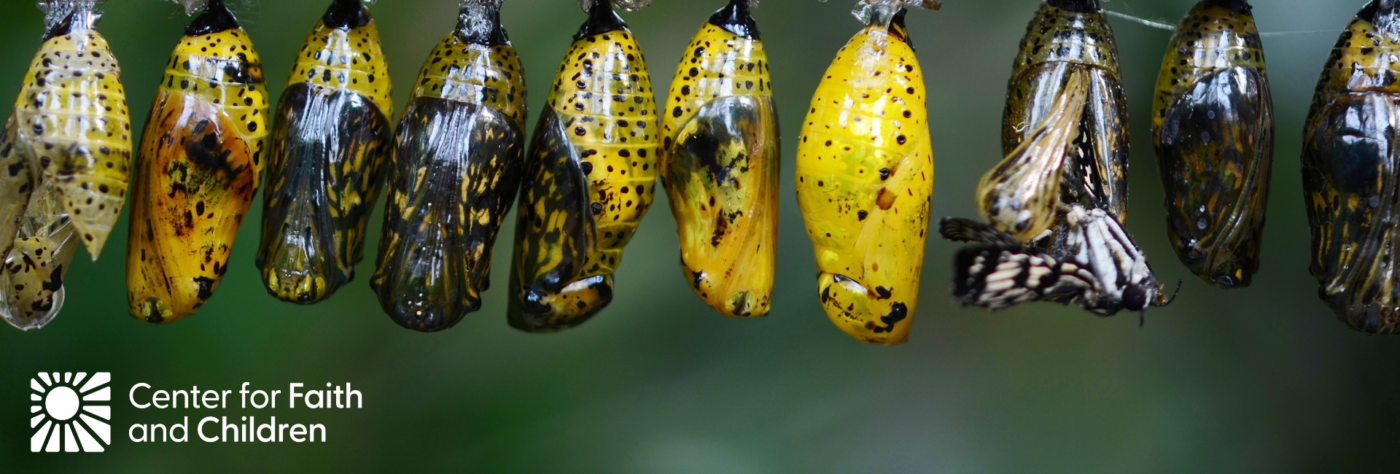
- Observe caterpillars and butterflies. You can order kits online and watch caterpillars transform into butterflies. You can connect this with the resurrection or becoming new creations, like 2 Corinthians 5:17.
Conclusion
“The more we familiarize ourselves with nature, considering its ways, details, and offerings, the deeper we know our Maker,” writes Lynum. When we explore art, we learn more about the artist; when we explore creation, we deepen our understanding and relationship with the Creator. Let’s be willing to get a little uncomfortable, wet, or dirty to experience the beauty of nature with the children we serve at church and home. We might be surprised that God will meet us there, too.