
Sparking the Imagination
We’ve all seen it. That little spark. Eyes widening. Open-mouthed. A sudden, “Oh! I get it!” For those who teach and catechize children in the local church, these are some of the most satisfying moments. The goal of discipleship, after all, is not cognitive understanding alone, but deeper apprehension of biblical truths at a heart-level that results in transformed affections, attitudes, and actions. A good teacher knows the difference and can spot it when it happens.
Yet many children’s ministry teachers sense that they are fighting an uphill battle to capture hearts and minds with the glory of the gospel and the beautiful reality of the kingdom of God. The forces of counter-formation are strong. How can a local church reimagine ways to teach doctrinal truths that reach deeper to shape the foundational world-and-life view of young children?
The answer can be surprisingly simple: get your hands dirty, literally. One of the most powerful ways to spark the imagination of young people is to intentionally connect the special revelation of Scripture to the general revelation of creation. This means using hands-on learning to show how the biblical story makes sense of the world and unlocks a rich understanding of God’s amazing design in creation and God’s good plan for our salvation. In other words, take your Bible outdoors!
Reviving a Kingdom-Vision
Children are growing up in an age of contested beliefs where religion has been relegated to the realm of private opinion. The Bible is too often treated as a source of self-help maxims or politically expedient one-liners. We can accidentally teach children that the Bible is an abstract document, like an owner’s manual or basic instructions before leaving earth. There is a better way. Dr. Kevin Vanhoozer put it succinctly:
“The drama of discipleship is less about identifying key propositional truths than inhabiting the Bible’s symbolic universe. It involves our ability to indwell the richly patterned story-world of the canon, to imagine the world that Scripture imagines and to mirror in our lives the reality that Scripture mirrors.” (Vanhoozer, Kevin. 2016. Pictures at a Theological Exhibition: Scenes of the Church’s Worship, Witness and Wisdom. Downers Grove, IL: InterVarsity Press, 194).
It is not enough to teach doctrinal truth in abstract terms; children need to feel the weightiness of the glorious truths of Scripture and awaken their hearts to the goodness of the gospel. This is ultimately a matter of heart-level transformation, not mere information transfer. It requires that we reframe discipling young children as an opportunity to gain a kingdom-vision of the world and to find their life within God’s redemptive story.
Gardening as a Tool for Discipleship
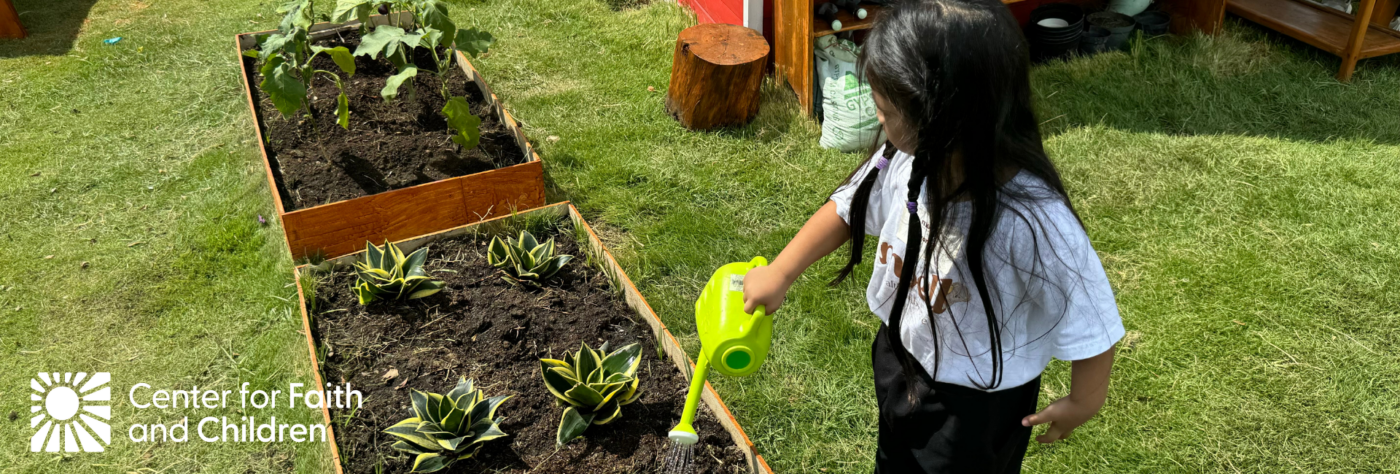
The local church where I serve as senior pastor recently began experimenting with creative ways to make the Scriptures come alive through hands-on learning. We developed a garden discipleship curriculum that traced the biblical-theological theme of creation to new creation while growing an actual vegetable garden in three large plots in front of our church. This 8-week program combined ecological lessons alongside biblical-theological teaching in order to show how general revelation vividly illustrates the special revelation of Scripture. Each lesson also included memory verses, hands-on activities, and songs with lyrics taken from that week’s Bible passage. All throughout, we saw the vegetables sprout, we pruned, we weeded, we watered, and we harvested. Likewise, we planted seeds of the Word in the hearts of the children, we saw them sprout, and we prayed for a harvest of redeemed and renewed hearts.
This program indeed yielded fruit. The students were given their own seeds to plant at the beginning of the program. One boy planted corn and took his role very seriously. He ensured the soil was ready, he gently coddled the tender sprout, he watered it, he weeded it, and he supported it with stakes. His eyes lit up when it formed an ear of corn. He couldn’t wait for the harvest! I’ll never forget a Sunday when his grandparents visited our church. He literally dragged them out of the car and across the parking lot to get to the garden plots so that he could explain how his seed had become a tall corn stalk with food to eat! He told his grandparents about the Bible lessons he was learning and you could see the eyes of his heart illuminated with the very words of God.
This approach may seem simple (and it is certainly not new!), but it is profoundly counter-cultural in today’s digital-saturated world. Children spend inordinate amounts of time in virtual interactions, consuming social media, or passing time with mindless entertainment. Putting down our screens and going outside into the sunshine is now a profound novelty, but it is better aligned with the way God designed us to learn. In fact, this is the model Jesus used. Dr. Donald Guthrie has said to me, “Creation was Jesus’s curriculum. I don’t know of any Rabbi who took his disciples on more field trips and picnics than Jesus!” Think of all the object lessons that Jesus taught with soil, seeds, weeding, pruning, and harvesting. The truths of God’s kingdom are captured in these metaphors and the growth of an actual garden makes them vivid and tangible. This is critical for children who need to experience concrete illustrations of these beautiful biblical truths.
Three Ways to Reimagine Catechesis
We need to think carefully about how to contextualize discipleship so that the truths of Scripture are vividly known and the reality of the kingdom of God can profoundly shape the hearts and minds of young children. I suggest that local churches aim to recover three foundational dimensions of discipleship in order to combat the counter-forming forces of late-modernity:
Embodied in People
We are creatures in a creation. We are embodied souls and ensouled bodies. Too often we choose to interact virtually with one another or we imagine our lives primarily through a disembodied digital perspective. There is no substitute for in-person discipleship. Local churches will need to preserve and promote a biblical vision for embodiment in the face of increasing pressure to adopt digital technologies that claim to eclipse human limitations. The limits of our embodiment are good and the uniqueness of our embodiment is sacred. Children desperately need a positive vision of biblical anthropology. How can your local church recover a vision for in-person ministry in an increasingly inhuman world?
Embedded in Places
We are called to care for creation. We are commanded to cultivate and protect this world as God’s image-bearers (Gen. 2:15). The specific place God has put your local church is part of his sovereign plan. What do you love about your place? How can your church contextualize discipleship so that the next generation will learn biblical truths by applying these truths in the unique place he has ordained for you? Whether your community is rural, suburban, or urban, the place you are embedded needs your church to love and serve your neighbors.
Enacted through Practices
We are designed to put biblical truths into practice so that there is consistent fruit of righteousness in our lives. If we want children to build their lives on a solid foundation, it is not enough to merely hear the word of Jesus; they need to put his words into practice (Matt. 7:24). Effective discipleship results in biblical ways of living. The ways of the kingdom of God must become integral and habitual. Consider how your children’s ministry can use hands-on learning to practice what the Scriptures teach. May our children learn to love God supremely and love others sacrificially as we teach them to taste and see the glory of the gospel of Jesus Christ.
Guest Blogger
-

Brent Kompelien
Brent Kompelien (DMin, Trinity Evangelical Divinity School) serves as Senior Pastor of New Life Evangelical Free Church in Hastings, Minnesota. He grew up in Silicon Valley and has previously served in pastoral ministry and church planting in Berkeley and San Francisco. He and his wife Sarah have two daughters.
https://www.nlefc.org/